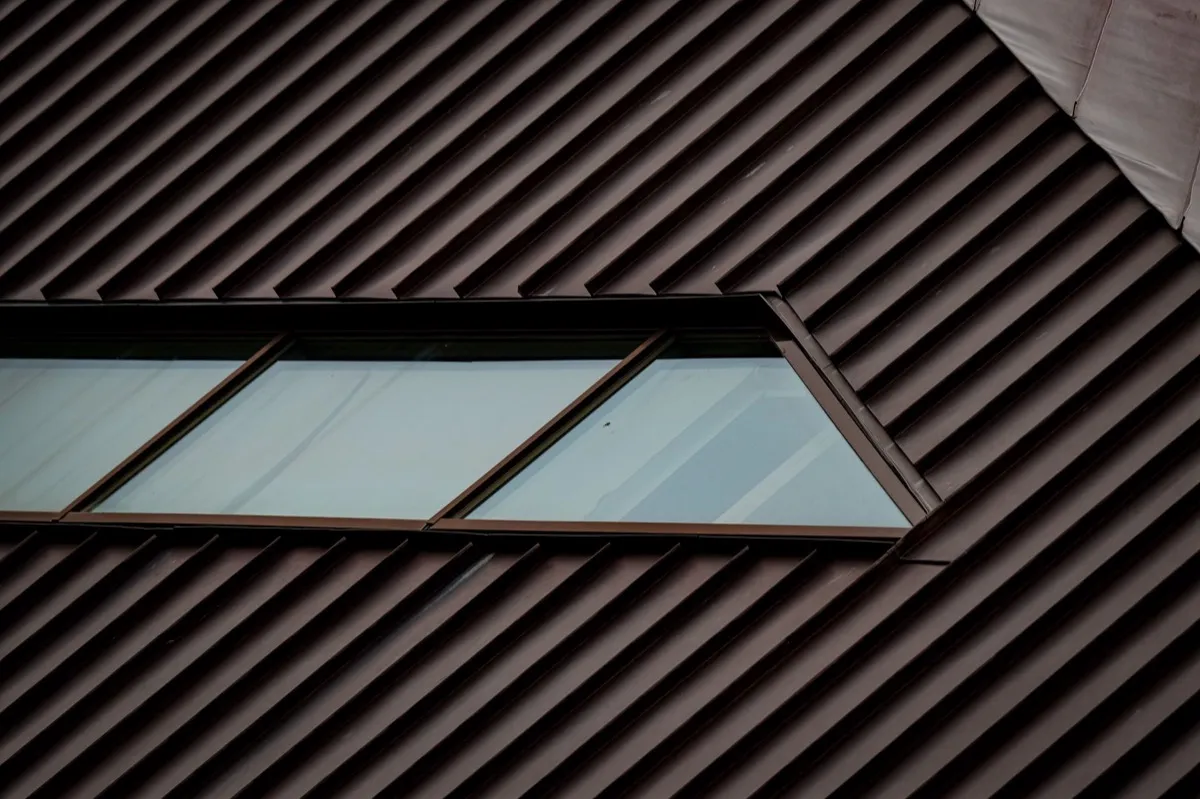
Metal costs roughly two to three times what architectural asphalt costs and lasts roughly two to three times as long. Almost every honest version of this comparison ends up there. The interesting question is not which material is better, it is which one is better for how long you actually plan to own the building.
Nobody has ever asked us this question casually. It arrives when a roof is already failing and there is a number attached to the answer.
What each one actually costs
Installed pricing swings hard with pitch, complexity, tear-off, decking condition and what the metal market did that quarter. Treat the shape of this as reliable and the exact figures as something to confirm on your own roof.
| Architectural asphalt | Exposed-fastener metal | Standing seam metal | |
|---|---|---|---|
| Relative installed cost | Baseline | ~1.5–2x | ~2.5–3.5x |
| Typical rated life | 25–30 yrs | 25–40 yrs | 40–70 yrs |
| Fasteners | Nails, concealed | Screws through the face | Clips, concealed |
| Main failure mode | Granule loss, mat bruising | Gasket and screw backing out | Panel oil-canning, flashing details |
| Re-roof labor | Straightforward | Straightforward | Specialized |
| Salvage at end of life | Landfill | Recyclable | Recyclable |
The line that matters most in that table is the fastener row. An exposed-fastener metal roof is a roof with several thousand rubber washers on it, and rubber washers have a shorter clock than steel. Budget a fastener walk every seven to ten years or the cheap metal roof becomes the expensive one.
Where metal genuinely wins
Long ownership. If you hold the building for 30 years you buy one metal roof or two asphalt roofs, and the second asphalt roof is priced in future dollars with future labor rates.
Low-slope and complex water paths. Standing seam handles slopes that asphalt is not rated for. NRCA and the shingle manufacturers both draw a hard line at 2:12 for asphalt, with doubled underlayment between 2:12 and 4:12. Below that, asphalt is not a debate, it is a code violation.
Wildfire exposure. Metal is non-combustible. In a wildland interface zone that is not a preference, it is often what the insurer wants to see.
Heat. A light-colored coated metal panel reflects a large share of solar gain instead of storing it. In a cooling-dominated climate that shows up on the utility bill, and it shows up in attic temperature, which is what actually cooks a roof from underneath.
Where asphalt is the right call and we will say so
Most of the time, honestly. Asphalt is the default for a reason and the reasons are good ones.
You are selling inside ten years. A new architectural asphalt roof is a fully effective selling point on a listing. Buyers read "new roof" and stop reading. You will not recover a metal premium at closing.
The roof is complicated and the budget is not large. Every valley, dormer, saddle and pipe on a metal roof is a hand-formed flashing detail priced by a skilled installer. On asphalt those same details are routine. Complexity inflates a metal bid much faster than it inflates an asphalt one.
Hail is your main threat and you want a claim to be simple. Impact-resistant Class 4 asphalt often earns a premium credit, replaces cleanly after a storm, and does not leave you arguing about whether dents are cosmetic. Metal dents and the dents are frequently ruled cosmetic. Ask us about Class 4 before you assume you need metal.
You have an HOA. Some architectural committees still treat residential metal as an agricultural look. Check before you fall in love with a panel profile.
Si prefieres que te expliquemos la diferencia entre teja de asfalto y metal en español, con los números de tu casa, lo hacemos sin problema.
The three myths worth killing
Noise. A residential metal roof sits on plywood decking over underlayment, and it is not measurably louder inside than asphalt. The loud roofs everyone remembers are corrugated panels screwed to open purlins over a barn or a carport, with nothing but air behind them.
Lightning. Height and geometry attract lightning, not metal. Metal spreads the energy across a wide conductive surface and does not burn. Insurers do not surcharge for it.
Heat. People assume a metal roof bakes the house because a metal slide burns your legs in July. Radiant reflectivity is what governs a roof assembly, and coated metal reflects better than a dark asphalt shingle does. The slide is not a roof.
What Texas requires of whoever installs it
Whichever covering you choose, the credential behind the installation is set by your state rather than by the manufacturer.
Texas issues no roofing license of any kind, so a state number is not something any roofer here can show you. A contractor also may not act as a public adjuster on a property it may work on, even holding an adjuster license.
The parts of the bid that decide the outcome
Both materials fail at the same places, and neither material saves a bad installation.
Ventilation. Intake at the soffit and exhaust at the ridge, balanced, with the intake not stuffed with insulation. A shingle roof over a dead attic cooks its mat from below and loses years off its rating. Our roof ventilation work exists because this is the most commonly skipped item on the entire job.
Underlayment. Synthetic over felt is now standard. Ice-and-water membrane at eaves, valleys and penetrations is worth paying for in any climate that freezes.
Flashing. Sidewall, chimney, valley and pipe. If a bid does not itemize new flashing, it is reusing the old flashing, and old flashing is where the next leak comes from.
Decking. Insist on a line item for replacing deteriorated sheathing at a stated per-sheet price. Every roof has some. A bid that pretends otherwise will produce a change order on day two.
The decision, compressed
Ask yourself one question: how many more years will you own this building? Under ten, buy good architectural asphalt and spend the difference on ventilation, flashing and a longer workmanship warranty. Over twenty, and especially with a simple roof shape, metal is very likely the cheaper roof measured across the time you own it. Between ten and twenty is a genuine toss-up that comes down to slope, complexity and whether you like the look.
One opinion, no hedging: never buy exposed-fastener metal for a house you intend to keep and ignore. It is a fine, economical roof for a shop, a barn or a porch. On a residence it is a maintenance schedule disguised as a permanent roof, and the people who are unhappy with metal roofing five years later almost always bought that one.
Bottom line
Metal is not better than asphalt. It is a different purchase with a different time horizon, and the price gap narrows the longer you stay. Get both bids on the same roof with the same ventilation, underlayment and flashing scope so you are comparing materials rather than comparing two different levels of care.
Brownsville Roof Pros installs and repairs both across Brownsville and Cameron County and the coastal end of the Valley — metal roofing, asphalt shingle roofs and full roof replacement. Call (866) 623-9449 and we will price your actual roof both ways, including the case for the cheaper one.
Ready for a free quote in Brownsville?
Brownsville Roof Pros — free estimate, clear scope, no pressure. Use the form on this page or jump to the homepage quote.
Related services in Brownsville
Brownsville Roof Pros money pages — go straight to the service you need.
- Roof Replacement →
A replacement here is a certification project with a roof attached. Cameron County sits inside the state's designated catastrophe area, so the order of operations is fixed by rule rather than by preference, and one missed step at the front cannot be repaired at the back.
- Asphalt Shingle Roofs →
Most of Brownsville is shingled, and most shingle failures here trace back to the nail rather than to the shingle. The wind rating printed on the wrapper is a laboratory result that only exists if the fastening on your roof matches the pattern the test used.
- Metal Roofing →
Metal is the one product where being twenty miles from open Gulf water changes the specification rather than merely the sales pitch. Salt arrives on the prevailing southeasterly straight across the bay flats, and it decides which panel and which fastener are still sound in fifteen years.
- Roof Leak Repair →
Water hardly ever enters a roof anywhere near where the stain shows up. On the shallow-pitch roofs common across this city it can travel the length of a rafter bay before it finds drywall, so a repair priced off the stain is a guess with an invoice attached.
- Storm Damage Restoration →
After a tropical system clears the coast, the first useful thing to establish is which of your two policies is actually in play. In this county wind and hail usually sit with the windstorm association while everything else sits with your regular carrier.
Frequently asked questions
Is a metal roof worth the extra cost over shingles?
It depends almost entirely on how long you plan to own the house. Metal typically costs two to three times what architectural asphalt costs and lasts two to three times as long, so the cost per year of service is roughly comparable. If you sell in seven years you pay the premium and hand the back half of the lifespan to somebody else. If this is the house you retire in, metal is very likely the cheaper roof.
Do metal roofs make more noise in the rain?
A metal roof installed over solid decking with underlayment is not meaningfully louder than asphalt inside the house. The noise reputation comes from barns and porch covers, where corrugated panels are screwed to open purlins with nothing but air behind them. That assembly is genuinely loud. A residential roof over plywood is not the same thing.
Does a metal roof attract lightning?
No. Lightning is not attracted by metal, it is attracted by height and geometry. What metal does is conduct the energy safely across a broad surface rather than concentrating it, and metal is non-combustible, so if your house is struck a metal roof is the better outcome, not the worse one. Insurers do not rate it as a hazard.
How long does a metal roof last compared to shingles?
Manufacturers generally rate architectural asphalt shingles at 25 to 30 years and quality standing seam steel or aluminum at 40 to 70 years. Real-world numbers are lower for both in a harsh climate. The controlling variable for metal is usually the fastener and sealant schedule on an exposed-fastener system, not the panel itself, which is why concealed-fastener standing seam ages better.
Can you install metal roofing over existing shingles?
It is sometimes allowed and it is sometimes a bad idea. Some jurisdictions permit one metal layer over one shingle layer, often with a batten or slip sheet, and it saves real money on tear-off and disposal. What it also does is hide the condition of the decking, which is the single thing you most want to look at during a re-roof. Ask for a decking inspection either way.
Which is better for hail, metal or asphalt?
Metal generally survives hail structurally while showing cosmetic dents, and asphalt generally survives it cosmetically until the mat bruises and then it leaks. Impact-resistant Class 4 asphalt closes much of that gap and often earns an insurance discount. If hail is a routine event where you live, ask specifically about Class 4 asphalt before assuming metal is the only answer.
Local context
How this applies in Brownsville, TX
Every article here is written from roofing work done in Brownsville and Cameron County and the coastal end of the Valley, so the numbers reflect local labour, permit and material costs rather than a national average. Your own job can land either side of them depending on access, the condition of what is already there, and the materials you pick — assemblies carrying a Texas Department of Insurance product evaluation, design wind pressures read from the 2024 code for the specific address, fastening schedules taken from the evaluation report rather than the wrapper.
The way to turn any of this into a real answer is to have someone look at your actual situation. The free estimate is free, itemized and written down, with no deposit and no obligation. Call (866) 623-9449 or start on the Brownsville Roof Pros homepage.
Areas Brownsville Roof Pros covers
Brownsville first, then the surrounding communities of Cameron County and the coastal end of the Valley. Each has its own page with local detail rather than a copy of this one:
- Harlingen, TX — Cameron County, population 71,829
- San Benito, TX — Cameron County, population 24,861
- Los Fresnos, TX — Cameron County, population 8,114
- La Feria, TX — Cameron County, population 6,817
- Port Isabel, TX — Cameron County, population 5,028
- Primera, TX — Cameron County, population 5,257
Or jump to the full list of Brownsville services.
More from the Brownsville Roof Pros blog
- How to Find and Fix a Roof Leak in Brownsville
Water rarely enters where the stain appears. Here's how to trace a roof leak in Brownsville, TX, what you can fix yourself, and what needs a roofer.
- How Long Does a Roof Replacement Take in Brownsville?
Most single-family re-roofs are one to three days of work. Here's the real timeline in Brownsville, TX, including the scheduling part nobody warns you about.
- How Long Does a Roof Last in Brownsville? Real Numbers
Rated life and actual life are different numbers. Here's what each roofing material really lasts in Brownsville, TX, and the signs yours is near the end.
The Brownsville Roof Pros Team
roofing specialists serving Brownsville, TX
Written by the Brownsville Roof Pros team — insured roofing pros serving Brownsville, TX and the surrounding area.